Counting the money was a major part of doing the papers. I’d watched Dad on a Sunday afternoon for so many years, as he spread newspaper on the table and emptied out all the leather moneybags, that when it came to my turn I barely needed any instruction. In turn, I picked out each denomination of coin from the heap on the table, and counted them into neat piles – twelve pennies in a pile, twenty shillings – then arranged them into ranks like soldiers on parade. Then we packed the coins into little paper money bags ready for the bank.
The coins were so distinctive then; threepenny bits and sixpences, pennies and shillings. There were also two-shilling coins, called florins, and two-shillings-and-sixpence coins, called half crowns, but they were discontinued in the late sixties, before decimalisation. There were notes for ten shillings, and for a pound. A guinea was 21 shillings, and although there was no guinea coin or note, luxury goods were often priced in guineas in the shops.
We always went home to a full roast dinner on Sundays. Whether we had beef, pork, lamb, or chicken, there was always Yorkshire pudding, roast potatoes, vegetables, and gravy. Mum did most of the prep the night before, and the oven came on with a timer while we were out.
Often, dad would fall asleep in the chair on a Sunday afternoon, his glasses sliding across his face so he looked like Eric Morecambe, but sometimes, especially in spring or autumn, we’d all go out again in the afternoon to collect nuts or berries. We collected cobnuts, elderflowers, elderberries, and blackberries in their seasons.
The elderflowers and elderberries were used for dad’s greatest hobby, wine-making. He always had several glass demijohns in the pantry, fermenting away, and I can picture him sitting over great plastic bins of liquid, stirring with a long wooden stirrer. He made wine from wheat, oranges, apples; whatever he could get hold of cheaply or free! Trays of less than perfect fruit from the market stall where mum worked, picked up at the end of the day, or sacksful of elderflowers that we’d collected.
Sometimes the smell of the fermenting fruit was overpowering. He was incredibly proud of his wine, and would check the bottles of a new batch for clarity like a connoisseur. Each bottle was carefully corked and labelled; each step of the process a perfect ritual. His wine was always good, sometimes exceptional, and at those times he’d pour a glass, hold it up to the light, take a sip, and say, “it’s the best I’ve ever made.”
Dad liked routine and was not really very suited to having four small, noisy, unpredictable children in the house. He was a perfectionist; whatever he did, he was concerned to do it to the highest possible standard, so that, for example, although he only decorated very rarely, when he did, his work was superb. In the evenings he would sit and watch television, with a cigarette constantly in his hand. He watched football and the news, and he loved Morecambe and Wise, and The Two Ronnies. He also watched Benny Hill, I think, and variety shows from London theatres, as well as wildlife and nature shows such as David Attenborough, and One Man and His Dog, about shepherding.
Mum would sit with him after she’d finally finished her housework for the day, and was usually asleep in the chair within minutes. They both drank sherry or wine every evening; when I was smaller, I’d be sent round to the wine merchant’s in East Street to refill a container with cheap sherry. How did I carry that? Mum didn’t smoke, but she was given a large box of Sobranie Cocktail cigarettes each Christmas, which I thought were incredibly glamorous, and she’d smoke one of them now and then.
Strangely, mum is a less clear figure in my childhood memory; she was always there, and always working. She was busy constantly and would never sit down during the day, except on her daily visit to her mum at coffee time. Her life was bound by other people’s needs and expectations: Nan wanted her round for elevenses every single day, Dad wanted his lunch on the table the moment he walked in at lunchtime every day.
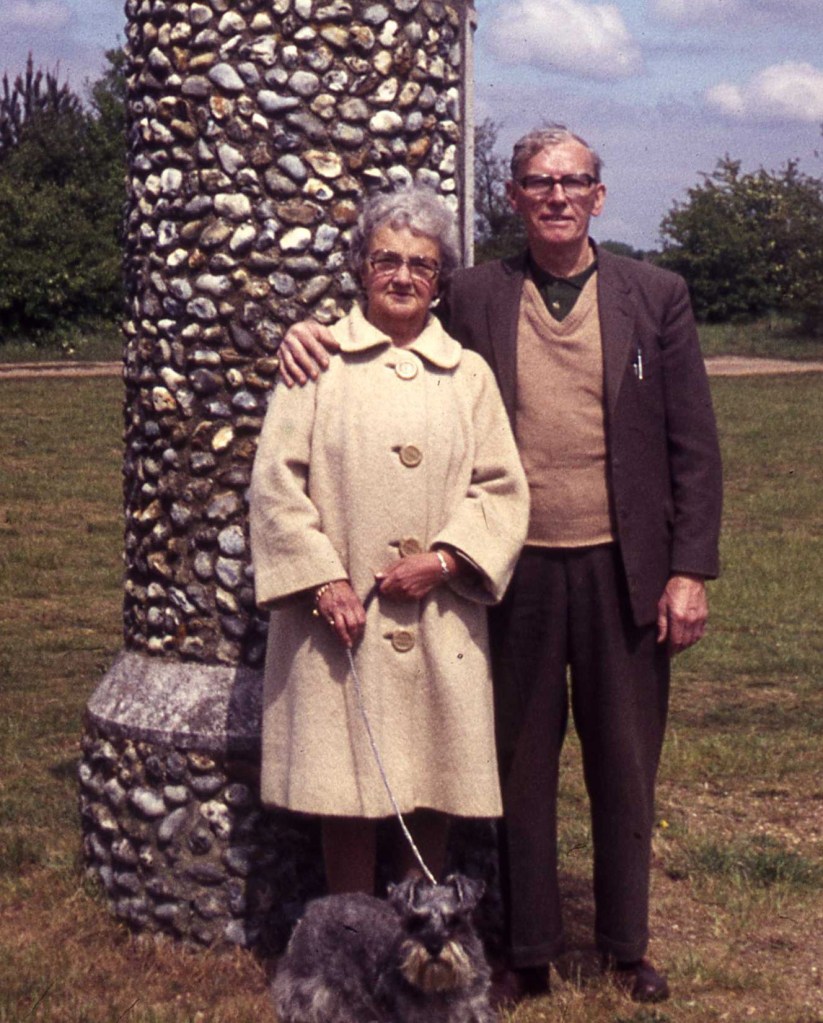
For a long time when I was small, Nan lived at 57 Queen’s Road, and it was fairly easy to walk there from Newman’s Road, through the alley and past the laundry, which had a very distinctive smell of wet washing. Nan made coffee according to a peculiar ritual, in a little brown jug set in a small pan of simmering water on the gas. She always ground the beans herself, freshly grinding just enough for that day’s coffee. When it was ready, she used a strainer to pour it into the cups.
She had nearly always baked something: scones or biscuits, sometimes a cake, although cake was probably for tea in the afternoon. Her days ran like clockwork, and she and her husband Ted would say the same things to one another at the same time each day – shall I put the kettle on, Nell? Morning coffee was at eleven. Mum rarely relaxed and enjoyed coffee time, she was always thinking about the next thing. When Dad was on days, she had to be home at lunchtime because he came home for lunch. He expected his food to be ready, on the table, as soon as he had washed his hands.
 Fading Memories
I was always fascinated by the siphoning process where he’d suck on the end of the siphon and just as the wine was coming to the end of it he’d hurriedly push it into one of the waiting bottles.
And the glug of the wine fermenting !
LikeLike